


Flat Drills vs. Standard Drills: Key Differences and When to Use Each
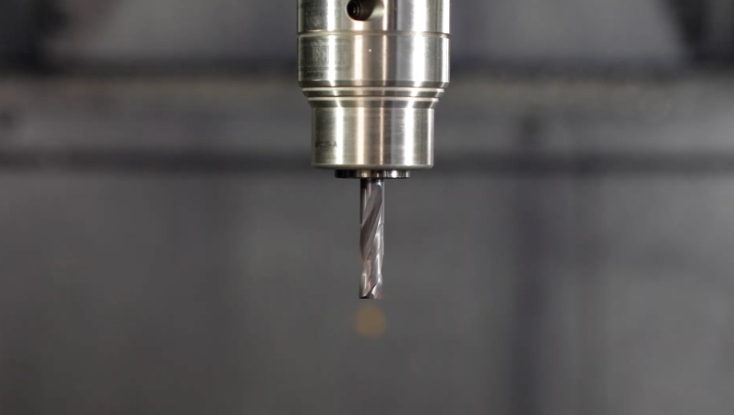
Drilling is a fundamental process in machining, but choosing the right drill type can significantly impact efficiency, precision, and overall production costs. Flat Drills — such as HPMT’s Flat Drill W15 — offer specialized advantages for machining flat-bottomed holes with higher accuracy and reduced secondary operations.
What Sets Flat Drills Apart?
Flat Drills are specifically designed for applications that require precision, efficiency, and stability in machining flat-bottomed holes. Unlike Standard Drills, which create conical holes, Flat Drills provide clean and level bottoms without requiring additional processes like end milling.
Let’s take a closer look at how these two drill types compare:
Flat Drill vs. Standard Drill: A Comparative Overview
| Feature | Flat Drill | Standard Drill |
|---|---|---|
| Tip Geometry | 180° point angle for flat-bottomed holes | 118°–140° point angle, creates conical holes |
| Hole Shape | Flat-bottomed holes, eliminating extra machining | Conical holes, requires end milling for flat surfaces |
| Industry | Mould & Die, Aerospace, Automotive, General Engineering, Energy | General-purpose drilling |
| Machining Stability | High stability, minimal deflection on inclined surfaces | Can deflect, requiring pilot holes for precision |
| Chip Evacuation | Optimized for smooth chip removal, reduces burrs | Standard design, may need peck drilling for deep holes |
| Surface Finish | Cleaner finish, reduces need for secondary processing | May leave burrs, requiring additional finishing steps |
Key Advantages of Flat Drills
Flat Drills offer unparalleled precision for machining flat-bottomed holes. Their 180° point angle eliminates the need for pilot holes and additional machining steps, making them ideal for applications where level-bottom holes are necessary.
The design ensures reduced tool deflection and higher stability, especially when drilling on angled or irregular surfaces, preventing inaccuracies and improving hole consistency.
Additionally, Flat Drills provide
superior chip evacuation and surface finish. Their optimized flute design enhances chip removal, reducing heat buildup and preventing tool wear, which results in a cleaner surface finish and minimizes the need for post-processing.
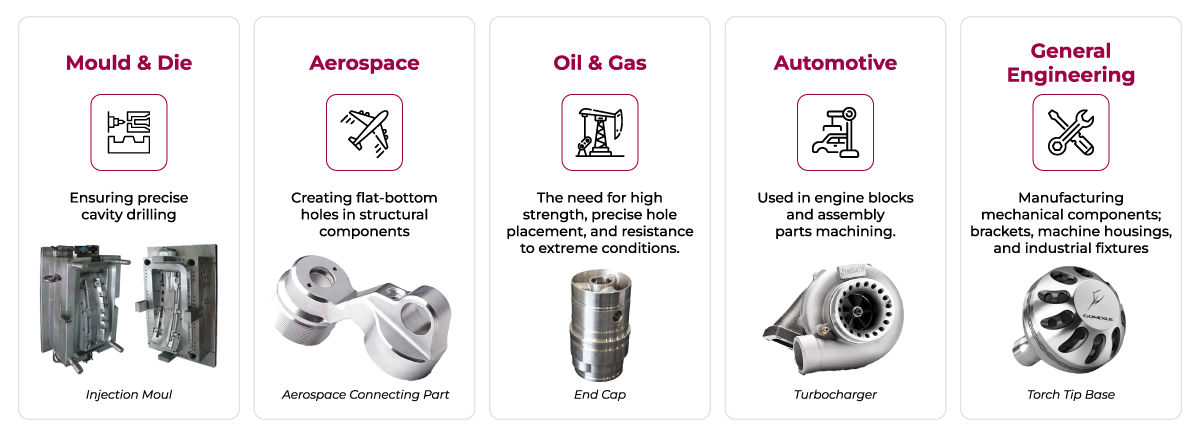
Flat Drills are highly versatile across multiple industries. Their ability to improve accuracy, efficiency, and surface finish makes them an essential tool in precision manufacturing. They are extensively used in:
Drilling Operations Suitable for Flat Drills
Flat Drills are engineered for specialized machining tasks where high precision, stability, and superior hole quality are required. It makes them the ideal choice for machining tasks that require clean, flat-bottomed holes. Unlike standard drills, which create conical holes that often require additional machining, Flat Drills provide a direct and efficient solution, reducing secondary operations and improving overall productivity.
These advantages make Flat Drills the preferred choice for the following drilling operations:
Flat Bottom Drilling
Standard drills create conical holes that require additional milling to flatten the bottom. Flat drills eliminate this extra step by producing a completely level hole bottom directly.
Common in precision machining for mould and die applications, aerospace, and medical industries.
Counter Boring on Inclined Plane
The flat-bottom design ensures simultaneous engagement across the surface, providing stability and preventing deflection. This allows for precise counterbore creation on angled surfaces without the need for preliminary milling or spot-facing operations.
Common in the aerospace and automotive sectors, where components often feature complex geometries requiring accurate seating for fasteners.
Counter Boring
Creating a larger recess at the top of a hole to accommodate bolts or fasteners. Standard drills require multiple operations to achieve this, but flat drills can do it in a single step.
Used in mechanical assemblies where a fastener’s head needs to sit flush with the surface.
Drilling Thin Plate
When drilling through thin plates, traditional pointed drills often push material through the exit hole, creating burrs on the underside. Flat drills, with their 180° flat-bottom geometry, apply even downward force across the entire cutting surface. This design minimizes material displacement and significantly reduces the formation of exit burrs, resulting in cleaner holes and reducing the need for secondary deburring operations.
This technique is particularly beneficial in industries like electronics and sheet metal fabrication, where thin materials are prevalent, and maintaining material integrity is crucial.
Blind Tapped Holes
Flat drills inherently produce holes with flat bottoms, eliminating the need for subsequent flattening operations. This ensures full thread utilization and enhances the strength of the threaded connection.
Widely used in manufacturing assemblies where components are fastened together, and maximum thread engagement is essential for structural integrity.
Intersecting Holes
Drilling at points where two holes meet can cause instability with standard drills, leading to tool deflection or chipping. Flat drills engage evenly, reducing vibration and ensuring smooth transitions.
Used in hydraulic manifold blocks and aerospace components where intersecting channels are required.
Correcting Eccentric Hole
When existing holes are misaligned or eccentric, enlarging or correcting them with standard drills can lead to further misalignment due to the drill's tendency to follow the existing path.
The flat-bottom geometry allows for material removal across the entire hole surface uniformly, enabling precise correction of the hole's position without the drill wandering.
Ideal for reworking or repairing components where hole alignment is critical, such as in precision machinery and tooling.
Half Moon Drilling
The design ensures stable engagement with the material, allowing for controlled and precise half-hole creation without deflection or damage to the workpiece.
Used in creating channels or grooves along the edges of components, commonly seen in fluid dynamics applications or specialized mechanical assemblies.
When to Choose a Flat Drill?
- If your machining process requires flat-bottomed holes without additional end milling, a Flat Drill is the most efficient choice.
- If you need high stability when drilling inclined surfaces, Flat Drills minimize deflection and maintain accuracy.
- If you aim to improve surface finish and reduce post-processing steps, the optimized chip evacuation of Flat Drills ensures superior results.
While standard drills remain essential for general-purpose applications, Flat Drills like the HPMT W15 offer unparalleled advantages for precision machining, reducing secondary operations, and increasing efficiency. Their flat-bottom design eliminates the need for extra milling, while their enhanced stability ensures accurate hole placement — even on inclined surfaces.
This advantage is backed by proven performance. In a recent tool test, the Flat Drill W15 achieved a tool life of 2,020 holes, surpassing a competitor’s tool, which lasted only 2,000 holes under the same cutting conditions. While the difference may seem minor at first glance, every extra piece matters in high-volume machining — helping manufacturers reduce downtime, minimize tool changes, and lower overall operational costs.
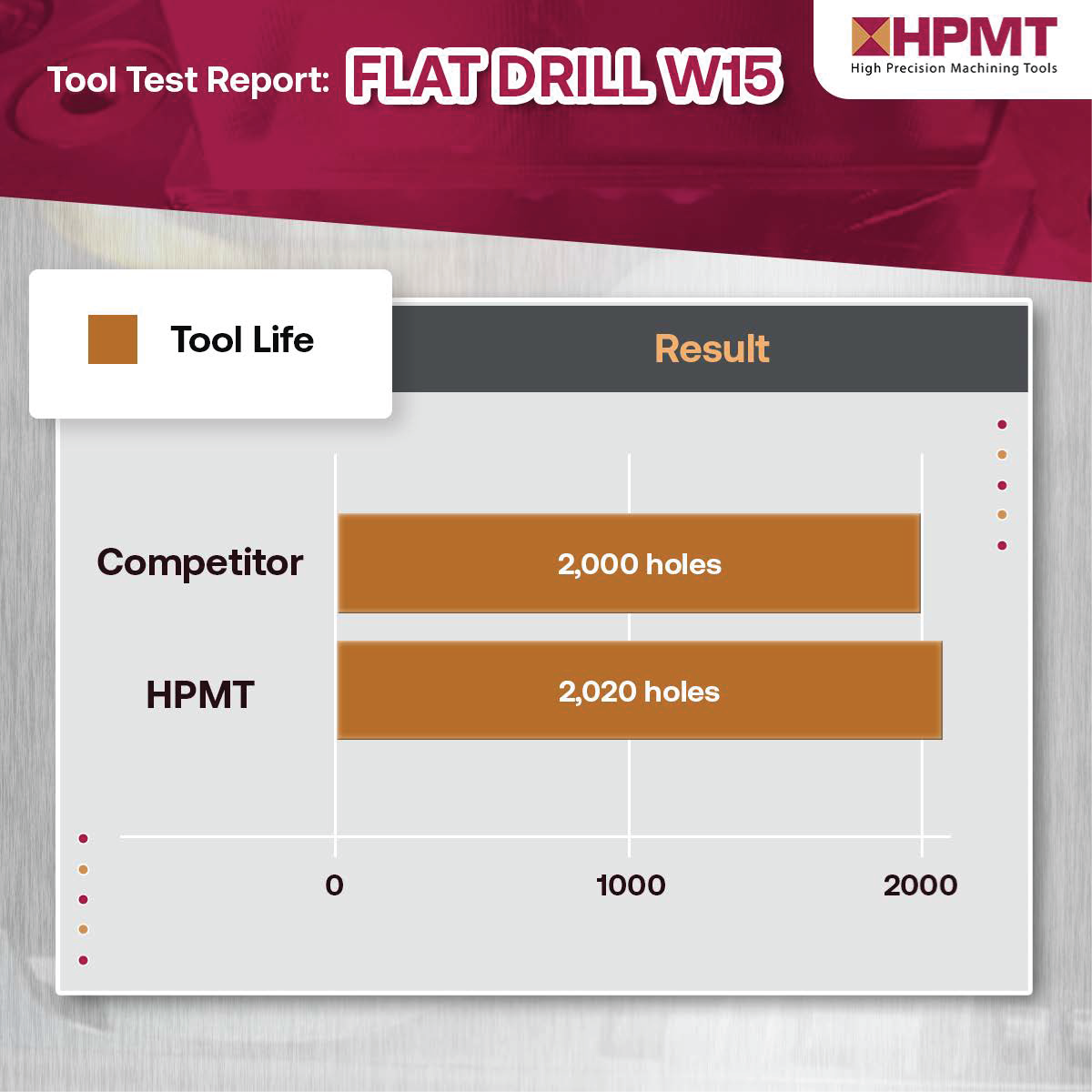
With its 180° point angle design, the Flat Drill W15 optimizes cutting performance, ensuring superior durability and precision even under demanding conditions. These advantages translate to greater efficiency and cost savings for manufacturers striving to enhance productivity.
Curious to see the Flat Drill W15 in action?
This video showcases how it excels on half-moon, 30° angle, 45° angle, cylinder profiles, and more. Gain insights into how the Flat Drill W15 optimizes efficiency, reduces secondary operations, and delivers exceptional results in machining flat-bottomed holes.
Beyond standard options, our Flat Drill range also caters to special requirements, offering customized solutions for varying hole diameters and lengths. This ensures manufacturers can achieve optimal performance tailored to their specific machining needs, further enhancing efficiency, consistency, and cost-effectiveness in high-precision applications.
At HPMT, our mission is simple: to empower manufacturers with tools that deliver results. Contact us today to explore how the Flat Drill W15 can transform your machining operations.